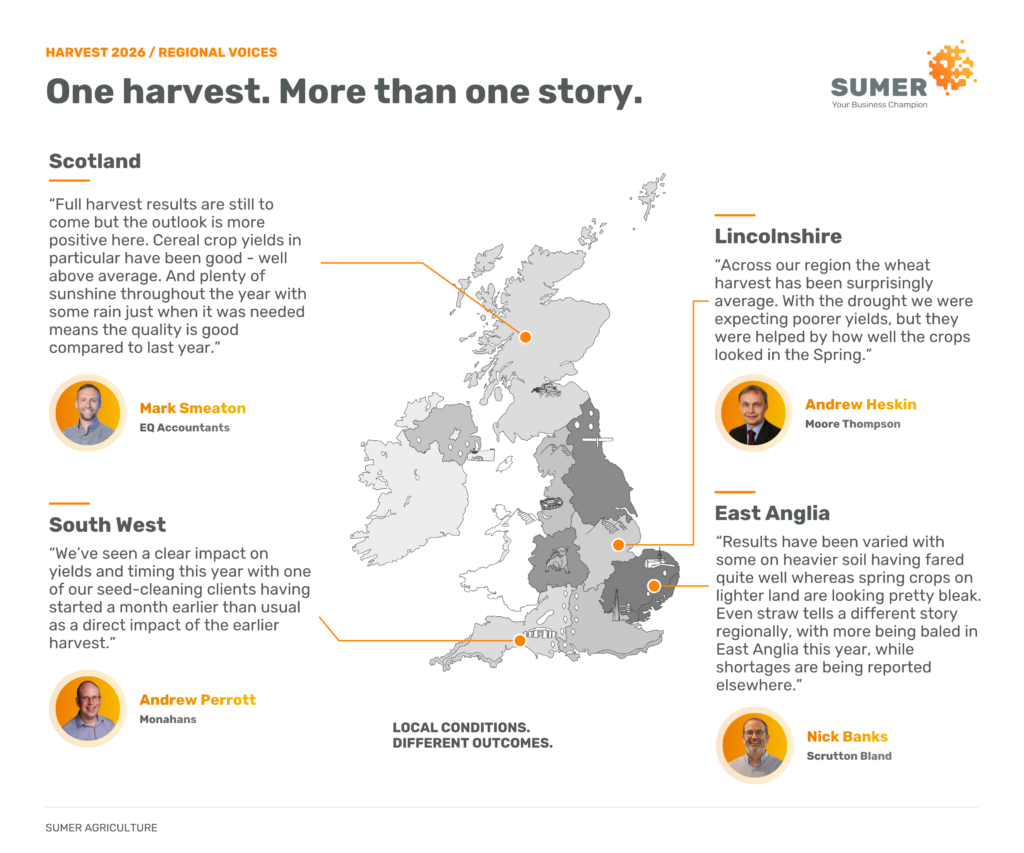
UK farmers have seen it all. Unpredictable weather, shifting policy and markets that move faster than a combine can cut a field – the conditions are rarely kind, and yet the sector keeps finding a way through. This year was no exception, and it certainly looked different depending on where you were standing.
But yield isn’t the full story
The regional picture is mixed, but one thing is clear: the story of the 2026 harvest can’t be told simply through yield statistics alone.
For farming businesses, what matters is what those yields mean when combined with costs, output prices and the cash available to fund the next growing season.
A good harvest doesn’t mean a profitable harvest
The experience of our clients in the East and Lincolnshire illustrates why yield alone can give a misleading picture of the health of a farming business.
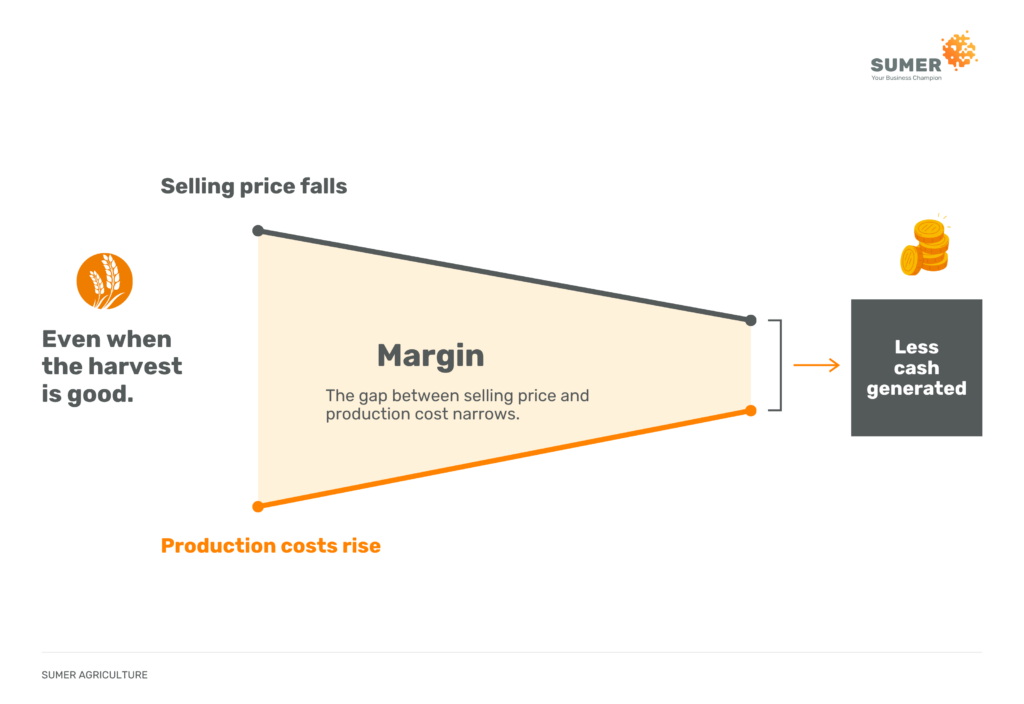
“Wheat yields have been surprisingly resilient despite the drought” but at the same time, “agricultural input inflation is running well ahead of the Consumer Price Index. Agricultural inflation is over 8% annually, while CPI is around 3%. And at the same time, the price index for agricultural outputs decreased by 4.3% in the 12 months to June 2026.” Andrew Heskin
For farmers, that creates a difficult squeeze. Because producing a reasonable crop doesn’t necessarily translate into a stronger margin if the cost of producing it is increasing while the price achieved for it remains under pressure.
The biggest impact is still to come
Of course, a farming business doesn’t experience each harvest in isolation. The pressure doesn’t end when the fields are cleared. In fact, some of the consequences of this year’s conditions are already being felt.
For livestock farmers in the South West, poor grass growth has meant many of our clients turning to winter feed earlier than usual.
“That not only puts pressure on stocks that would normally need to last further into the winter but with lower crop yields too, it’ll likely mean higher feed costs next year as supplies become harder to source.“ Andrew Perrot
The 2026 growing season didn’t begin with a clean slate either. The impact of 2025 carried forward into this one, with farmers already having had to manage extreme field-to-field variability, strong yields twenty miles from disappointing ones, margins that depended as much on grain price as on what came off the combine, and no two farms facing quite the same year.
That makes the decisions being made now particularly important.
In the East and Lincolnshire, some of our clients are already scaling back investment plans as higher costs and uncertain returns make the coming growing season harder to plan.
And whilst holding back on investment can protect cash in the short term; delaying machinery, infrastructure or other improvements may have longer-term implications for productivity. Equally, committing significant capital when margins are under pressure can leave a business with less room to manoeuvre if conditions deteriorate further.
As one of our advisers put it, “two dry summers, rising costs and static or falling output prices are making medium-term planning increasingly difficult.” Cash flow constraints only add to that pressure.
For those further North and into Scotland, the picture looks brighter as one of our Aberdeenshire clients confirmed “potato test digs would suggest yields will be back on those of the last few years. It will definitely be a later start to lifting however initial signs would suggest demand will be outweighed by supply. I am quietly confident though”.
Such optimism is good to see, but the question remains as to whether these farmers invest now for the future, or hold back and see how the market develops?
What comes next?...
“The strongest farming businesses won’t necessarily be those that predict the year perfectly, but those with the flexibility and financial resilience to respond when reality differs from the plan.”
Mark Smeaton – Agricultural Lead | North
The harvest figures are only the starting point.
Once the combines are back in the shed, there’s the opportunity to look at how much financial headroom this year’s harvest has given you to make decisions about the future.
Look at:
- Where did any margin actually come from?
Which crops, enterprises or activities performed well once the full cost of production is taken into account? - How much cash will the business need over the next 12 months?
Consider upcoming input costs, feed, tax, finance repayments and planned investment alongside the income you expect to receive. - Which investments are essential, and which could wait?
With cash under pressure, understanding the difference between protecting future productivity and simply spending capital becomes increasingly important. - What would happen if next year was another difficult one?
Stress-testing cash flow against lower yields, higher costs or weaker output prices can highlight where the business has limited room to manoeuvre. - Where could you create more flexibility?
Perhaps changing the timing of investment, reviewing borrowing, improving working capital, considering diversification or simply understanding the numbers in more detail.
Predictably unpredictable
Farmers have always managed uncertainty. What’s changing is the number of variables you need to manage at the same time. Weather, costs, prices, financing, tax and investment decisions are increasingly interconnected.
The 2026 harvest may have produced very different results across the country, but the question for farming businesses remains the same: are you in a strong enough position to respond to whatever comes next?
We’re here to help
The next growing season is impossible to predict. But understanding your numbers can help you prepare for different outcomes.
And with a Budget coming that could add even more unpredictability, now’s a great time to get in touch.
Our agricultural experts work with farmers and landowners to look at the bigger picture, from cash flow and investment to tax, finance and longer-term planning.
Talk to one of the team today to find out how we can help.