Understanding a farming business means more than looking at the numbers — it means walking the fields, seeing the machinery in action, and hearing directly from the people building the business. That’s exactly what our Agriculture & Estates team set out to do when they visited James Foskett Farms and Foskett Willows in Bromeswell, Suffolk.
It’s a philosophy that runs through our agricultural business champions across the network: our advisers aren’t just crunching figures from a desk, they’re getting out to see how their farming and rural clients actually operate, so the advice we give is grounded in a real understanding of the business.
A family business built over three generations
James Foskett Farms is a long-established family operation spanning 1,105 hectares of owned, contracted, tenanted and licensed farmland, producing conventional and organic vegetables alongside combinable crops for anaerobic digestion, all within roughly 35 miles of the farm.
The business has enjoyed considerable recent recognition, winning the Suffolk Farming Award for Best Farming Business over 501 hectares in 2025, followed by the National Arable and Grassland Award for Organic Carrot Grower of the Year in 2026. Our team was keen to understand what lies behind that success.
James walked the team through the farm’s history: from his parents’ purchase of 180 acres in 1955, through his own tenure at the helm, to his daughter Jess joining the business in 2024 — bringing a new generation into the fold.
With no existing buildings to repurpose for diversification, James took a different route and diversified in the way that the crop were grown. That thinking led to the farm’s organic specialism around 20 years ago, with more land converted to organic production each year since.
Investment, infrastructure and expert guidance
Touring the farm’s facilities gave the team a real sense of the scale of investment behind the operation. James was open about the role that professional advice, including guidance from his accountants at Sumer, has played in shaping funding and investment decisions over the years. Those decisions have resulted in facilities that support every stage of the growing and production process, from planning and planting through to harvest, processing, packing and distribution.
James Foskett, James Foskett Farms
“Scrutton Bland have supported us through every stage of the farm’s growth -from major investment decisions to the day-to-day financial detail. What sets them apart is that they take the time to properly understand the business, not just the numbers behind it. Their advice has been invaluable in helping us to be a successful business and to plan with confidence for the future.”
It was clear throughout that technology; a skilled workforce and rigorous quality control all work together to keep produce consistently meeting high standards and that strong organisation and communication sit behind it all.
The team was also struck by the farm’s approach to people. A core team of full-time staff is supplemented by seasonal workers at busier times of year, with around 70% of seasonal staff returning each season, a strong signal of good management and a positive working environment.
Sustainability in practice
Environmental stewardship was visible everywhere on the visit. from machinery chosen to protect and improve soil health, to participation in environmental schemes. The results speak for themselves: the farm is now home to a wide range of wildlife, including Egyptian geese, numerous butterfly and moth species, damselflies, dragonflies and water birds.
From willow to cricket bat
The visit also included time with Guy Foskett of Foskett Willows, who showed how land unsuitable for traditional arable cropping can be turned into a valuable diversification opportunity through willow growing. Guy explained why English willow is so prized for cricket bat production, with much of the UK’s harvest exported to bat manufacturers worldwide.
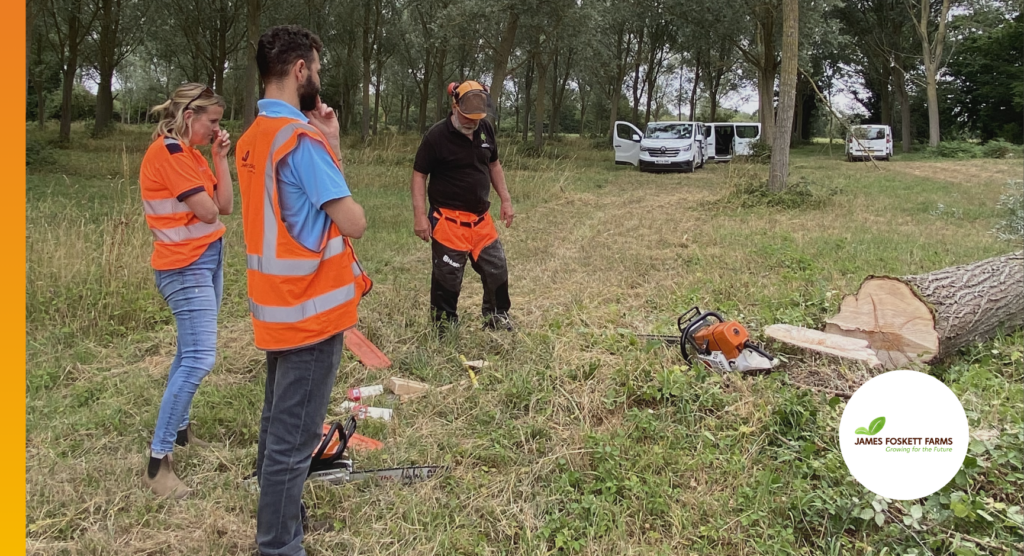
The team followed a willow tree’s full journey — from being felled, through marking, sawing and shaping into clefts, to drying in the kilns, grading and eventual export. Even the bark and offcuts are put to use, fuelling the kilns and minimising waste, an approach that has earned Guy a Best Green Practice Award.
Why visits like this matter
For our Agriculture team across all regions, days like this are central to how we work. Getting out to see a farm in operation, talking to the people running it, understanding the decisions behind the investment, and seeing the outcomes in the fields – means our advice is built on real knowledge of the business, not just its accounts.
We’re grateful to James, Guy and their teams for their generosity in sharing their time, knowledge and experience. The visit was a reminder of both the scale of innovation happening in modern agriculture and the dedication it takes to produce high-quality, sustainably grown crops and products.